
What Cloudmore Is
Cloudmore is the Commerce Control Plane - the operating layer between vendors who create services and the customers who consume them. It gives the reseller in the middle a single system to manage the entire commercial lifecycle: catalog, pricing, provisioning, billing, governance, and self-service.
Today, that means Cloudmore is how Brokers run Microsoft CSP, Azure, and a growing portfolio of third-party cloud services for thousands of Organizations. Tomorrow, it means a unified commercial architecture that can handle any combination of subscription, usage, consumption, and hybrid models across any vendor ecosystem.
Cloudmore is not a product you configure once. It is a platform - a foundational layer that becomes part of a Broker's technology stack in the same way as Salesforce, ServiceNow, or SAP. Brokers build their commercial operations on it, integrate it with their existing systems, and extend it through APIs to power end-to-end automation at scale.
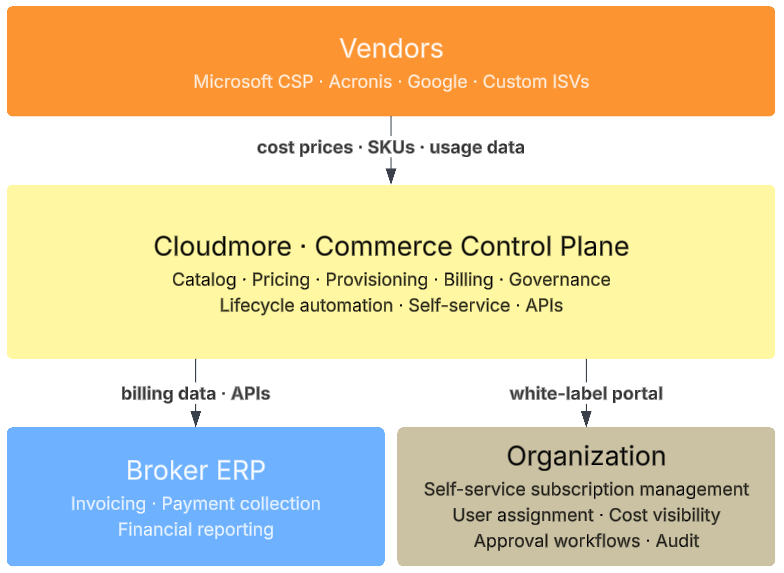
Cloudmore does not replace ERPs, CRMs, or ITSM tools. It sits above and alongside them, feeding them clean, structured commercial data. It doesn't process payments or generate invoices. It ensures that what's sold can be provisioned, what's consumed can be billed, and what's billed can be governed and audited.
Read more about the platform overview
The Core Problem Cloudmore Solves
Many businesses are moving from one-time product sales to service-based models such as subscriptions, usage-based consumption, and hybrid pricing. However, most commercial systems in use today were designed for static contracts and do not natively support these models.
As a result, Brokers managing cloud services must handle a growing set of operational challenges, including:
-
Consolidated Microsoft invoices where usage for many Organizations and SKUs is combined into a single file
-
NCE rules that enforce fixed commitment terms, limited cancellation windows, and restricted mid-term changes
-
Azure consumption data that is finalized after the billing period ends, requiring post-period reconciliation
-
GDAP security requirements that require granular, time-bound access permissions per tenant
-
Frequent Microsoft rule changes that affect pricing, eligibility, and billing logic across the customer base
These challenges cannot be handled effectively in traditional ERP systems or spreadsheets. As the number of customers, vendors, and pricing models increases, the complexity compounds.
Cloudmore addresses this gap by providing a dedicated commercial control layer designed specifically for multi-party, subscription- and usage-based commerce.
It centralizes pricing, subscription lifecycle management, consumption handling, and governance in a single platform that integrates with existing financial and operational systems.
Cloudmore Adoption Stages
This is the most important mental model for understanding how Brokers adopt Cloudmore and where value accrues. Nearly every Broker follows this progression - they arrive at Stage 1 and discover Stages 2–4 over time.
1️⃣ Stage 1 - Billing integrity
Core problem: The Broker can't bill reliably.
Microsoft reconciliation takes days. Revenue leaks through manual errors. Nobody can answer "what is our margin on this customer?" with confidence.
Cloudmore establishes a trusted billing foundation: automated reconciliation, usage tracking, structured billing exports. The platform pulls the Microsoft invoice, splits it by Organization, SKU, and usage type, applies the Broker's pricing rules, and produces a billing report ready for ERP export. If any tenant is unlinked or any data is missing, the platform raises a warning.
At this stage, Cloudmore pays for itself through accuracy alone.
2️⃣ Stage 2 - Governance and reconciliation
Core problem: The Broker can bill, but can't govern.
No visibility into margins across customers. No spending controls for Azure. No audit trail for who changed what and when. No way to demonstrate compliance to customers who require it.
Cloudmore becomes the single commercial source of truth: pricing governance across the entire customer base, Azure spending budgets with threshold notifications and optional auto-suspension, approval workflows that gate actions above configurable financial thresholds, and a complete audit trail of every subscription change.
3️⃣ Stage 3 - Self-service and customer experience at scale
Core problem: The Broker's customers can't easily buy more, upgrade, or manage services without generating support tickets.
Every seat change is a ticket. The support team is a bottleneck for routine changes, and the cost of servicing those requests erodes the margin on every seat sold.
Cloudmore enables customer self-service through a white-label portal and APIs. Organizations manage their own subscriptions, adjust seat counts, assign licenses, and view billing - directly, without calling the Broker. The Broker retains control over pricing, policies, and approvals.
This is where something important happens: the Cloudmore-powered portal becomes the experience through which the Broker's customers interact with services daily. The Organization never sees the Cloudmore brand. They see the Broker's logo, the Broker's colors, the Broker's domain. They experience governed self-service, cost visibility, and audit trails as capabilities the Broker provides. That perception is a competitive differentiator - it makes the Broker stickier and shifts their value from processing transactions to providing a platform their customers rely on.
4️⃣ Stage 4 - Business model expansion
Problem: The Broker wants to expand.
Expand to new pricing models, new vendor ecosystems, new commercial structures. Cloudmore enables subscription, usage, consumption, and hybrid models without re-plumbing integrations. Adding a vendor from the Marketplace or creating a custom service doesn't require engineering work.
This is also where Cloudmore's multi-tenant, single-codebase architecture creates a longer-term structural advantage. Over time, the platform can surface benchmarks and optimization suggestions grounded in real transaction patterns across the ecosystem - an intelligence capability that becomes available as the customer base matures. This is not a shipped feature today; it is an architectural advantage that compounds with growth.
At Stages 1 and 2, Cloudmore pays for itself through integrity and governance.
At Stages 3 and 4, Cloudmore becomes a growth, margin, and differentiation driver.
What Changes for the Broker
Invoice reconciliation
Microsoft sends one consolidated invoice. Cloudmore splits it automatically by Organization, SKU, and usage type, applies margins, and produces a billing report that reconciles with the Microsoft invoice. Brokers close their books in hours, not days.
Pricing and margin control
Brokers set global prices and per-Organization overrides through the UI or API. Pricing rules support fixed margins, discount percentages, fixed unit prices, or any combination. When Microsoft changes prices, the impact is visible immediately across the entire customer base.
Multi-vendor service catalog
All services live in one catalog (the EStore) with consistent pricing, margin logic, and subscription lifecycle management. Adding a new vendor from the Marketplace takes minutes, not months.
Subscription lifecycle management
The platform enforces NCE rules natively and prevents non-compliant changes before they reach Microsoft. Renewal dates surface with advance notifications. At renewal, the platform supports scheduled changes - product switches, quantity adjustments, auto-renewal toggles - all configurable in advance.
Cloudmore maintains a bidirectional, real-time sync with Microsoft Partner Center. Changes flow both ways, so Brokers who still have staff working in Partner Center won't experience data drift. However, only changes made through Cloudmore carry a full audit trail - an important reason to centralize operations as the Broker scales.
Billing integration with ERP
A single API call retrieves structured monthly billing data (also exportable as CSV/Excel), ready for ERP import. One integration point replaces dozens of manual workflows.
Customer self-service
The white-label portal allows Organizations to manage subscriptions, assign licenses, view billing, and track costs - branded as the Broker's own platform. See Stage 3 of the Maturity Journey for why this matters beyond operational efficiency.
Commercial model
Cloudmore's pricing is based on a percentage of the Broker's sales revenue flowing through the platform, structured in tiers that decrease as volume increases. Most Brokers fund Cloudmore in full or in part through Microsoft Co-op programs.
What the Organization Experiences
Organizations access Cloudmore through their Broker's branded portal. They never see the Cloudmore brand.
Self-service operations. Add or remove subscriptions, adjust seat counts, assign and unassign user licenses, view renewal dates - directly, without calling the Broker.
Cost visibility and governance. Billing reports show cost per subscription and per user. Licenses can be split across cost centers with billing allocated proportionally. Azure spending budgets trigger notifications at configurable thresholds. Organizations see their own sales prices (never cost prices), including per-subscription breakdowns and a usage report with metadata exportable for their own BI analysis.
Approval workflows and audit. Approval processes gate actions above price thresholds (configurable per Organization). Every action is recorded with user, timestamp, and details in an exportable audit trail.
What Cloudmore Is Not
These boundaries matter - internally for how we position, and externally for how we set expectations.
Not an ERP or invoicing system. We generate structured billing data. ERPs consume it.
Not a CRM. We don't manage customer relationships. We ensure that what's sold can be correctly provisioned, governed, and billed.
Not an ITSM tool. We work alongside service management systems (ServiceNow, Autotask, etc.), triggering and consuming operational events through APIs.
Not a FinOps or cost optimization tool. We handle the commercial layer - what you're billing and why. Resource-level optimization (should you switch to reserved instances?) is handled by complementary tools that often use Cloudmore's pricing data as their source.
Not just a cost-saving tool. At maturity, the impact is measured in growth, margins, and differentiation - not only in efficiency.
Not an iPaaS. Cloudmore uses integration extensively, but its value is the commercial model and control layer, not point-to-point connectivity.